Already Have Your Own Class Management Software? Calculate What It Really Costs Before You Build Another Feature
“We already have our own software.”
For a school, academy, dance studio, sports club, tutoring business, or other after-school education provider, that can sound like a good reason not to consider another system.
But the real question is not whether you already have software.
It is:
How much will that software cost you over the next 12 months?
Clasero lets you stop funding standard software development yourself and use workflows that are already built and maintained for after-school businesses.
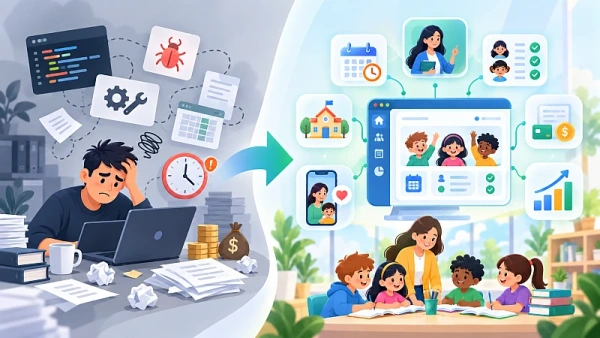
Think of it as specialized after-school class management software that can take part of the development burden off your organization. Instead of commissioning another scheduling feature, billing workflow, report, or parent-facing tool, you can first check whether Clasero already provides it.
That changes the comparison from:
“Our software versus another subscription.”
to:
“Another year of maintenance, development, manual administration, and technical dependency versus software that may already provide what we are planning to build.”
Your own software still has a real annual cost
Custom software may not produce a monthly SaaS invoice, but that does not make it free.
Its costs are often spread across different budgets and employees.
To understand your real software maintenance costs, calculate what the system required during the last 12 months:
- Developer or IT support
- Hosting and infrastructure
- Bug fixes and technical updates
- Security and compatibility work
- New features and integrations
- Staff time spent defining requirements
- Staff time spent testing changes and coordinating developers
- Manual work caused by missing functionality
Then estimate the same costs for the next 12 months.
Technical dependency matters too.
If one employee, freelancer, agency, or software company understands most of your custom class management software, how easily could someone else maintain it if that person became unavailable?
There is also a cost to waiting. While a custom feature is being specified, developed, tested, corrected, and released, employees may continue using the manual process that the feature was supposed to replace.
A serious custom software vs SaaS comparison therefore needs to look forward, not backward.
How many hours would Clasero need to save to cover its cost?
A simple calculation makes the decision more practical:
Annual Clasero cost ÷ actual hourly employment cost = break-even administrative hours
Where possible, use the real employment cost of the employee doing the work, not only their take-home pay.
The result shows approximately how many working hours Clasero would need to save in one year for the value of those hours alone to equal its subscription cost.
Then compare that figure with the administrative hours your team actually spent last year.
Development costs should be considered separately.
If Clasero already provides a feature that you were preparing to commission, the development, testing, and future maintenance of that feature may no longer be necessary.
Use your real business costs rather than assumed savings.
The better question is not simply:
“How much does Clasero cost?”
It is:
“What work and future development could Clasero replace?”
One recurring task can change the calculation
Invoicing is a good example.
The Clasero specification describes one dance school teacher managing around 200 students who previously spent more than four hours each month preparing individual invoices. In that specific case, using Clasero saved at least those four hours of recurring monthly work.
If the same workload occurred every month, that represents around 48 hours over a year.
That is one specific example, not a guaranteed result for every organization.
But it demonstrates an important point: useful class billing software should be judged by the work it removes, not simply by whether an invoicing feature exists.
Clasero supports subscription and pay-as-you-go payment models. For pay-as-you-go services, recorded visits can be used when calculating charges for invoicing.
That means attendance and billing can form part of the same workflow instead of becoming two separate administrative tasks.
Before building the next feature, check whether Clasero already provides it
Compare Clasero directly with your software development roadmap.
Planning to build recurring class scheduling?
Clasero already supports lesson planning by branch, class, teacher, room, lesson time, and recurring schedule.
Planning to improve attendance management?
Teachers can record student attendance as part of the lesson workflow.
Planning to add teacher availability checks?
Clasero can warn users when a teacher is unavailable at the selected lesson time.
Planning to automate billing?
Clasero already supports multiple payment models and automated invoicing.
Planning better reports across multiple locations?
Clasero reporting can cover all branches or be filtered by individual branches and classes.
Planning a better parent-facing system?
Parents can use my.clasero.com to access relevant schedules, attendance records, invoices, and lesson information.
All of these functions could be custom-developed.
The important question is whether they should be.
Before using development budgets to recreate standard functionality, check what specialized school administration software already provides.
What should actually remain custom?
Clasero does not need to replace every unique process.
The goal is to stop paying custom-development prices for functions that are standard across the industry.
Use a simple test:
Could another dance school, sports academy, language school, tutoring business, or after-school program reasonably need the same feature?
If the answer is yes, check specialized software first.
Scheduling, attendance, teacher availability, billing, reporting, and parent access are common operational requirements.
Reserve custom development for processes that are genuinely unique to your organization—not simply missing from your current software.
Connected workflows matter more than isolated features
The value increases when the workflow is connected:
schedule → attendance → billing → reporting → parent access
Instead of repeatedly moving the same information between spreadsheets, separate applications, emails, and reports, the data can remain part of one operational flow.
For businesses working across several locations, this also makes multi-location class management easier to organize without building separate administrative processes for every branch.
Already have years of customer data? Include switching costs honestly
Changing systems has costs too.
Migration may involve configuration, staff training, process changes, and sometimes a temporary period when both systems operate in parallel.
Include those costs in the comparison.
Clasero supports importing existing customer and student information from Excel or Google Sheets. Its setup process also guides businesses through configuring branches, premises, services, classes, employees, teachers, payment settings, and other essential information.
Compare both options in the first year:
Clasero subscription + migration and onboarding effort
versus
existing-system maintenance + planned development + manual administration
Then compare the following two or three years as well.
One-time switching costs can make the first year look very different from later years. Do not assume either option is cheaper. Use your own numbers.
Seven questions before approving another software project
Before signing off on the next development request, ask:
- What did our existing software really cost during the last 12 months?
- How much will maintenance and planned development cost during the next 12 months?
- What standard feature are we currently planning to pay someone to build next?
- Which planned features already exist in Clasero?
- How many staff hours are still spent on spreadsheets, duplicate entry, calculations, and manual workarounds?
- Which requirements are genuinely unique enough to justify custom development?
- If our current developer became unavailable tomorrow, how easily could someone else maintain the system?
If your existing system already meets your needs, costs little to maintain, and requires minimal further development, keeping it may make sense.
But before approving the next custom feature, compare what it will cost to build and maintain with what Clasero already provides.